

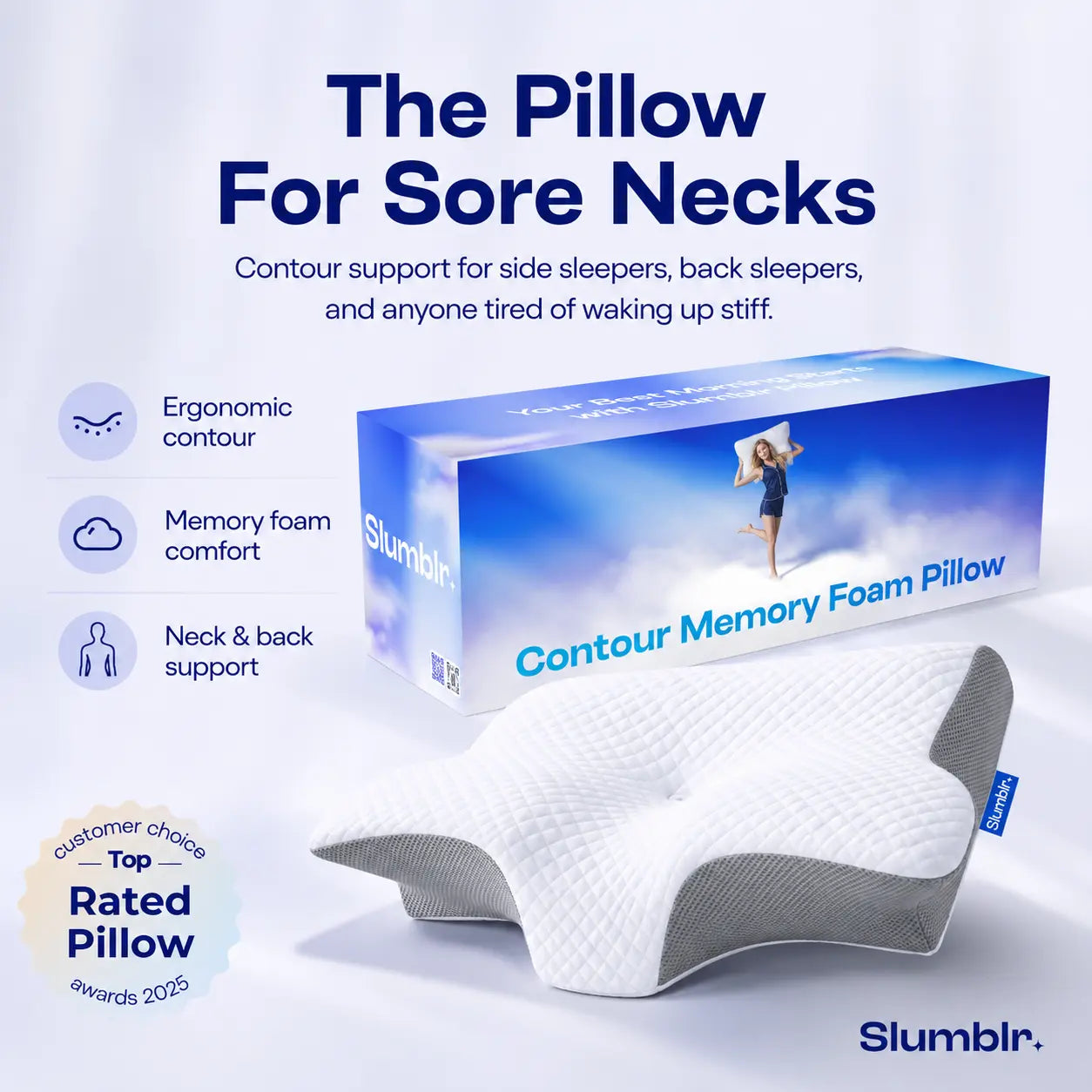




























Most side sleepers never question their position. Sleeping on your side is, after all, widely considered one of the healthiest ways to rest. It's better for the airway, easier on digestion, and generally recommended for people who snore or deal with acid reflux.
But here's what nobody warns you about: side sleeping puts a very specific set of demands on your body that your standard pillow was never designed to meet. And when those demands go unmet night after night, they show up as a sore ear in the morning, a stiff neck by midday, or a shoulder that just never seems to fully recover.
This guide breaks down the three most common pain points for side sleepers and what actually addresses each one.

The problem with side sleeping nobody talks about
When you sleep on your side, the full weight of your head, which averages about 10 to 12 pounds, presses down on one ear and one shoulder for hours at a stretch. Your neck has to bridge the gap between that weight and the mattress below, which means it's either too elevated, too compressed, or straining to hold a neutral position the whole night.
Add in the reality that most people don't stay perfectly still while they sleep, and you have a recipe for accumulated pressure, restricted circulation, and morning stiffness that gets normalized as just "how I feel when I wake up."
The three pain points that tend to develop are distinct, and they need different solutions.

Pain point 1: ear pressure and piercing pain
For people with ear piercings, earbuds they fell asleep wearing, hearing aids, cartilage sensitivity, or a condition called chondrodermatitis nodularis helicis (CNH), side sleeping on a standard pillow is actively painful. The ear gets compressed against a flat surface and held there, sometimes for hours.
The natural response is to wake up and reposition, or to prop your hand under your head to create some clearance. Neither actually solves the problem.
The design solution is simpler than most people realize: if the ear doesn't touch the pillow, there's no pressure. That's the entire logic behind a donut or O-shaped pillow for side sleepers.
The Slumblr® Ear Piercing Donut Pillow is built specifically around this principle. Its 3.5-inch center opening keeps the ear completely suspended, with the pillow surface supporting the head around the ear rather than pressing against it. The fill is a cotton-polyester blend inside a breathable cotton cover, with a zipper that lets you adjust the firmness up or down depending on how much height you need. At 9 inches square and 2.7 inches thick (adjustable), it's compact enough to use on its own or stacked with your existing pillow. It's also OEKO-TEX certified and machine washable, which matters when you're dealing with a healing piercing.
For anyone managing cartilage piercings, helix or industrial piercings, CNH, or just general ear soreness from side sleeping, this kind of purpose-built clearance is what actually works, not repositioning or improvised workarounds.

Pain point 2: ongoing ear sensitivity and broader side sleep support
The donut pillow is purpose-built for concentrated ear relief in a compact format. But some side sleepers need something that goes further, supporting not just the ear but the full neck-to-shoulder curve that gets strained during side sleeping.
The Slumblr® Adjustable Ear Support Pillow takes a different approach. At 17.3 by 12.6 inches, it's a full-length side sleeper pillow with the same 3.5-inch ear clearance channel built into a longer curved body. The shape is designed to follow the natural contour from neck to shoulder, cradling the side of the head while keeping the ear suspended. The fill is PP cotton, adjustable via a side zipper, inside a 100% cotton pillowcase that's breathable and gentle on sensitive skin.
Where the donut pillow is focused, this one is comprehensive. It suits people who aren't just dealing with a fresh piercing or a specific ear condition, but who need the entire side-sleeping experience to feel better: less pressure on the ear, more natural neck support, and a surface that doesn't require constant adjustment through the night.
Both pillows address ear pressure. The difference is scope. If your primary issue is a sensitive or healing ear, the donut form factor is targeted and effective. If you're a side sleeper who wants a more complete support solution, the adjustable ear support pillow covers more ground.

Pain point 3: neck stiffness and cervical misalignment
Ear pain and shoulder soreness get a lot of attention, but neck stiffness is often the most persistent problem for side sleepers and one of the hardest to address with a sleep pillow alone.
Here's why: during the day, most people spend hours with their head slightly forward (looking at screens, at desks, at phones). This gradually flattens the natural C-shaped curve of the cervical spine. By the time you lie down at night, your neck is already carrying tension from a full day of suboptimal positioning. Side sleeping with a pillow at the wrong height adds more strain on top of that.
The result is a neck that never fully recovers overnight and wakes up tight.
The Slumblr® C-Shaped Orthopedic Pillow is not a sleep pillow. It's important to be clear about that. It's a cervical stretcher for daily use, not overnight rest. What it does is address the daytime accumulation of neck tension before you go to sleep, so you start the night with a more relaxed and better-aligned cervical spine.
The dense foam structure, measuring 8.7 by 6.9 by 4.9 inches, creates a three-way stretch: horizontal, upward traction, and a gentle follow of the cervical curve. Placing the back of your neck on it for around 10 minutes works to decompress tight areas and help restore the natural C-curve that forward head posture gradually erodes. It works best on a flat surface like a floor or yoga mat.
For side sleepers who wake up with a stiff neck regardless of what pillow they use, the problem is often not the pillow at all. It's the tension that accumulates during the day and never gets released before bed. A 10-minute session with the C-shaped orthopedic pillow in the evening is a practical way to address that upstream problem rather than just treating the symptom with a better sleep pillow.

Putting it together: the side sleeper approach
These three products aren't competing solutions. They address different layers of the same problem.
If you have ear piercings, cartilage sensitivity, CNH, or use hearing aids or earbuds at night, the donut pillow is the most targeted fix. It removes the source of pressure rather than trying to soften it.
If you want comprehensive ear-free support that also helps with neck and shoulder alignment during sleep, the adjustable ear support pillow covers the full range of side sleeping needs.
If you wake up with neck stiffness that persists through the morning, the C-shaped orthopedic pillow used during your pre-sleep routine can meaningfully change how your neck feels when you wake up, by addressing the tension built up during the day before it follows you into sleep.
Used together, they form a complete approach: address the daytime tension before bed, sleep with proper ear clearance, and let the full cervical contour of a side sleeper pillow do the rest.

One thing worth knowing about side sleeping position
Regardless of which products you use, pillow height matters more than most people realize. A pillow that's too flat lets the head drop toward the mattress. A pillow that's too thick pushes the head up and laterally flexes the neck. Neutral means the spine stays straight from the tailbone through the cervical vertebrae, with no tilt in either direction.
If you consistently wake up with shoulder or neck pain on the side you sleep on, check your pillow height before anything else. And if you wake up with ear pain, you probably already know your pillow isn't accounting for the most obvious thing: the fact that your ear is in the way.
The good news is that both of those problems have straightforward, purpose-built solutions. You just have to know they exist.




Leave a comment
This site is protected by hCaptcha and the hCaptcha Privacy Policy and Terms of Service apply.