






























Most pillow advice stops at firm, medium, or soft. That is the least useful axis to shop on, because firmness only tells you how a pillow feels when you press it, not what it does once you are lying on it for eight hours. Shape is what decides which part of your body gets supported and whether the support survives you rolling over. This guide covers the two shapes that solve genuinely different problems, and how to tell which one your nights are asking for.

Why does pillow shape matter more than firmness?
Shape matters more because it determines where support sits and whether it stays there. Firmness only describes resistance to pressure. A very firm pillow in the wrong shape still leaves a gap under your neck, and a soft pillow in the right shape can hold a position all night.
Think about what actually goes wrong at 3 a.m. Very few people wake up thinking their pillow was too soft. They wake up because their head has tilted at an angle, their shoulder is compressed, or their top leg has dropped across the mattress and twisted their hips. Those are all geometry problems, and you do not solve geometry by changing density.
The second reason is that shape decides whether a pillow stays put. A rectangle has nothing holding it in position when you move. A shape built around your body has to be dislodged rather than simply slid off, which is why shaped pillows tend to still be doing their job in the morning.
What does a contour pillow actually do?
A contour pillow is built for the head and neck specifically. Its profile is not flat: it has raised and recessed sections designed so the neck is supported at a different height from the head, filling the gap that a flat pillow leaves between your neck and the mattress.
That gap is the whole reason contour pillows exist. On a standard pillow, your head rests on the surface and your neck bridges empty space, so the muscles that should be resting overnight spend the night holding your head in position instead. A contour profile removes the bridge.
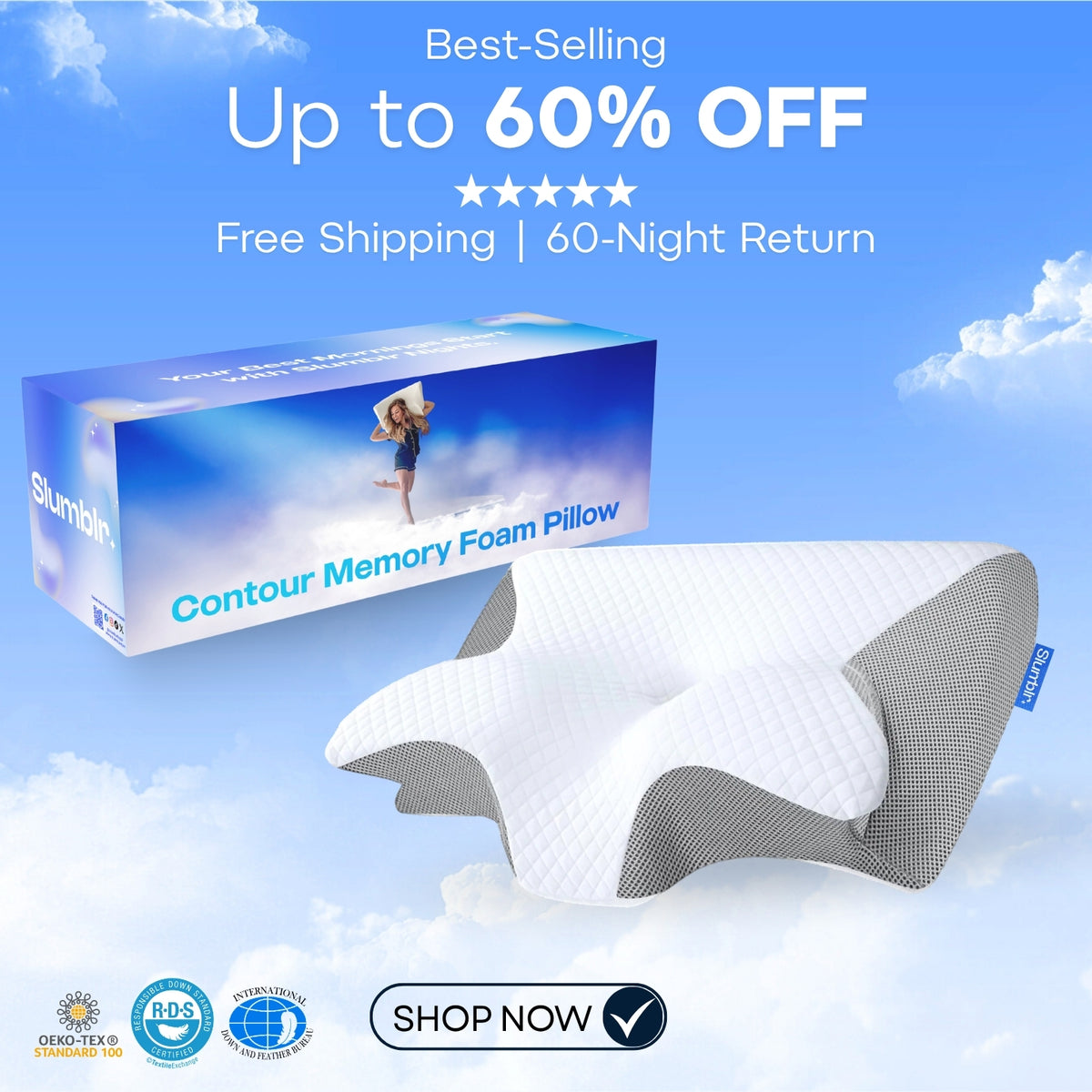
The Slumblr® Contour Pillows 2.0: Elevated & Enhanced uses what the product page calls a dent and bulge groove system, a contoured profile intended to adapt to your posture rather than present one flat plane. The added height and loft in this version are aimed at people who found standard pillows sat too low, which is the most common complaint that sends someone looking for a contour shape in the first place.
The core is slow-rebound memory foam, which matters for a shape-based pillow more than for a flat one. Slow rebound means the contour holds its profile under your head instead of bottoming out, so the shape you bought is the shape still working at 4 a.m. The cover is a breathable rayon and polyester blend, removable and washable with a zip, and it comes in light grey and dark grey at 23.7 by 15.7 by 4.92 inches. It carries a 4.6 rating from 250 reviews, which is a substantial sample for this category.
One honest limitation: a contour pillow supports your head and neck and nothing else. If your problem is below your shoulders, this shape cannot reach it.

What is a C-shaped pillow for?
A C-shaped pillow is a body pillow, not a head pillow. It is large, it curves around you, and its job is to support the line of your body from chest to knees while you lie on your side, so your spine, hips, and top leg stay in a reasonable relationship to each other overnight.
The problem it addresses is different from the neck problem. When you sleep on your side without body support, your top leg drops forward onto the mattress and rotates your pelvis, your top arm falls across your chest, and your torso slowly twists. None of that is painful at the time. All of it is why side sleepers wake with hip and lower back complaints.
The Slumblr® C-Shaped Pillow is built around that geometry. Its three-dimensional C shape wraps around the body and, as the product page puts it, addresses the fact that regular pillows often shift or fail to support the body evenly during side resting. The wrap is the functional part: because it curves around you rather than sitting beside you, it does not get left behind when you shift position.
The scale tells you it is a body product rather than a head one. It comes in 28 by 55 inches (70 by 140 cm) and 31 by 59 inches (80 by 150 cm), with plush cushioning and a smooth fabric cover that holds its shape. There are seven colours, which is unusual for this category and useful if it is going to be a permanent and highly visible object on your bed. It carries a 4.5 rating from 212 reviews.
Beyond sleep, the shape works for propped-up lounging and reading, which is how a lot of people end up using one more hours per day than they expected.

Contour or C-shape: which one do you need?
These are not competing options, which is the part most shopping guides get wrong. They support different parts of your body, so the right question is not which is better but which problem you have.
Choose a contour shape if your symptoms are above the shoulders. Waking with a stiff neck, a tension headache, the sense that your head was at a wrong angle all night, or finding yourself folding your current pillow in half to get more height under your neck all point to a head and neck support problem.
Choose a C-shape if your symptoms are below the shoulders. Hip soreness, lower back ache that is worse in the morning than at night, waking with your top knee flat on the mattress, or a persistent habit of hugging a duvet or spare pillow all point to a body support problem. The duvet-hugging one is worth paying attention to, because it means your body has already identified the need and improvised a poor solution.
If your answer is both, that is normal and common, particularly among side sleepers. For a wider view of how ear, neck, and shoulder pressure interact when you sleep on your side, our side sleeper's pain relief guide covers the full picture.
Can you use a contour pillow and a C-shaped pillow together?
Yes, and for side sleepers it is often the setup that finally works. They occupy different space and solve different problems, so there is no conflict between them. The contour pillow goes under your head. The C-shape goes around your body.
There is one adjustment worth knowing about. Once you are hugging a body pillow, your shoulder position changes and sits slightly differently against the mattress, which can make a head pillow feel marginally too high. Give it a few nights before deciding the contour height is wrong, because what usually settles is your shoulder rather than the pillow.
The practical order is to fix the louder problem first. Add one shape, live with it for a week or two, and see what remains. People who buy both at once often cannot tell which one helped, and if something is still not right they have no way to work out which half to change.

How do you know your current pillow is the wrong shape?
The clearest signal is improvisation. Folding a pillow in half, stacking two, wedging a rolled towel under your neck, or hugging a spare pillow all mean your body is building the shape it needs out of whatever is available. Each of those improvisations names the shape you should be buying.
A second signal is the timing of your symptoms. Discomfort that is worst on waking and eases through the morning points at your sleep setup. Discomfort that builds through the day and is worst by evening usually points at your chair, your desk, or how you sit, which is a different problem with different fixes.
A third is position drift. If you start on your side and consistently wake on your front with your head turned sharply, your setup is not stable enough to hold the position you intended to sleep in.
If you are weighing up loft, firmness, and replacement timing alongside shape, our guide to the things to know before buying your next pillow covers the other variables.
When is a pillow not the answer?
A pillow changes how your body is positioned at night. That is a real and often underestimated factor, and for a lot of people it is the whole explanation. It is not the explanation for everything.
Pain that persists after several weeks with a properly fitted setup, pain that wakes you repeatedly, or any neck or back symptoms accompanied by numbness, tingling, weakness, or radiating pain into the arms or legs should be assessed by a healthcare professional rather than managed with bedding. The same applies if symptoms followed an injury.
Give a new shape two to three weeks before you judge it, since a setup that changes your sleeping position usually feels worse before it feels better while your body adjusts. But if genuine effort on the setup has not moved anything, the next step is a professional opinion rather than a fourth pillow.

FAQ
What is the difference between a contour pillow and a C-shaped pillow?
A contour pillow supports the head and neck, using a raised and recessed profile to fill the gap a flat pillow leaves under the neck. A C-shaped pillow is a body pillow that wraps around your torso and legs to keep your spine and hips aligned while side sleeping. They solve different problems and work well together.
Are contour pillows good for side sleepers?
They can be, because side sleeping creates the largest gap between head and mattress of any position. The Slumblr® Contour Pillows 2.0 adds height and loft specifically for people who find standard pillows sit too low under the neck.
Do you need a body pillow if you already have a good head pillow?
Only if your symptoms are below the shoulders. A head pillow cannot affect hip rotation or where your top leg lands. If you wake with hip or lower back soreness, or you already hug a duvet at night, that is the gap a body pillow fills.
How long does it take to get used to a contour pillow?
Usually two to three weeks. A contour profile holds your head in a different position from the one your muscles are used to, so an adjustment period is normal and is not a sign the pillow is wrong for you.
What size C-shaped pillow should I get?
The Slumblr® C-Shaped Pillow comes in 28 by 55 inches and 31 by 59 inches. The larger size gives more coverage down the legs, while the smaller one is easier to manage on a smaller bed or when sharing with a partner.
Can the wrong pillow shape cause neck pain?
It can contribute, by holding your head at an angle for hours at a time. If neck pain persists despite a well-fitted pillow, or comes with numbness, tingling, or weakness, it is worth having assessed by a healthcare professional rather than treated as a bedding problem.



Leave a comment
This site is protected by hCaptcha and the hCaptcha Privacy Policy and Terms of Service apply.