















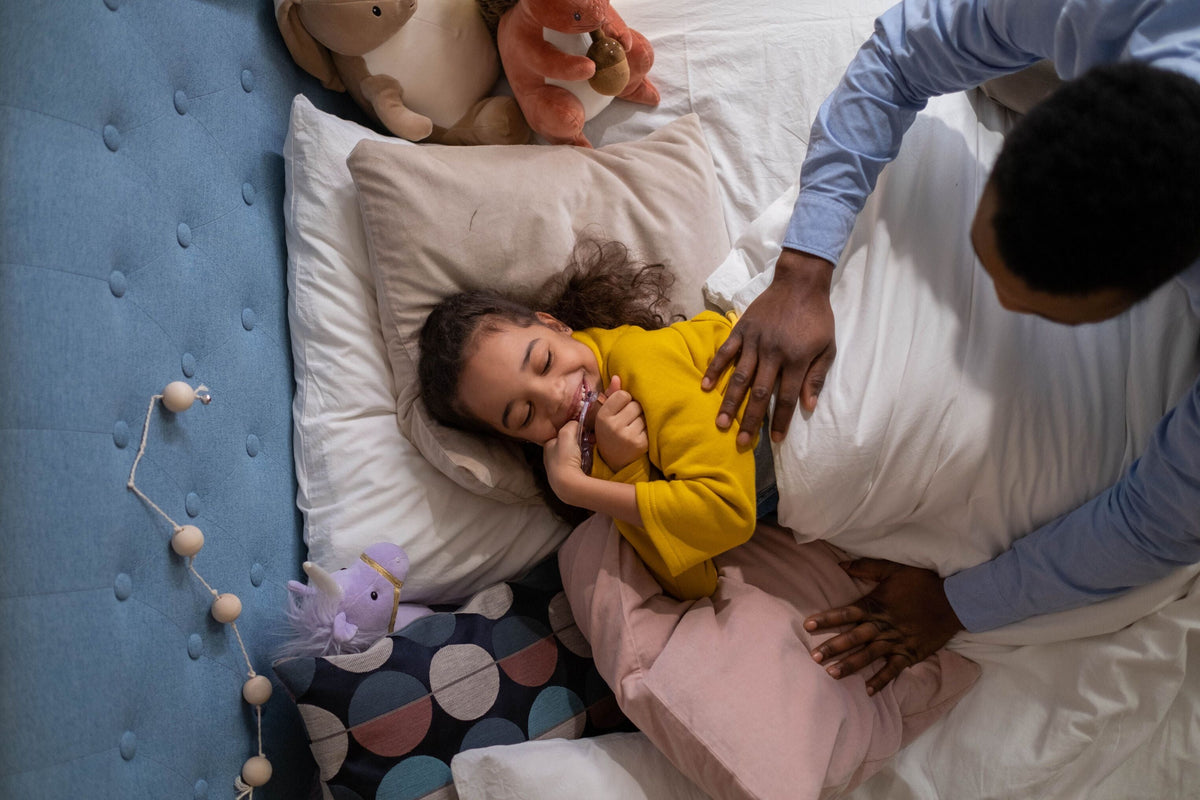
Almost every child who sleeps well alone has something in the bed with them. A particular bear, a blanket with a frayed corner, a pillow they have decided is theirs. Parents often treat this as a quirk to be tolerated and eventually outgrown. It is closer to the opposite: for most children the object is doing real work, and understanding what that work is makes it much easier to choose something that helps rather than something that just takes up space in the bed.
Why do children settle better with something to hold?
Children settle better with something to hold because falling asleep alone is a skill, and a familiar object gives them something to focus on while they practise it. The object does not make a child sleepy. It gives them a way to manage the gap between you leaving the room and sleep arriving, which is the part most children find hard.
The second thing it does matters even more, and it happens when nobody is watching. Children surface briefly several times a night, as adults do. An adult rolls over and goes back to sleep without remembering it. A child who wakes to an empty bed may need an adult to get back down. A child who wakes and finds the same familiar thing still there can usually settle themselves.
That is the whole mechanism. The object is not a substitute for you. It is a tool the child uses to do the last step on their own, which is exactly the thing you want them learning.

Is a comfort object just a habit a child has to break later?
Not usually. Most children let go of a sleep comfort object gradually and on their own, without it ever becoming a problem to solve. Treating it as a habit to be broken tends to create a fight over something that was quietly helping.
It is worth separating two different things parents often lump together. A child who needs a parent physically present to fall asleep has learned that your presence is a required ingredient, and that does cause night wakings, because the ingredient disappears. A child who holds a pillow has learned to settle with something that stays in the bed all night. The first creates a dependency on you. The second reduces it.
The practical question is therefore not whether to allow one, but whether the one they have is actually suited to the job.
What makes a good comfort object for sleep?
Four things, and most soft toys fail at least one of them.
Big enough to hold properly. A small toy gets lost under the duvet at 2 a.m., which produces exactly the wake-up you were trying to prevent. Something a child can get an arm around stays findable.
Stays in the bed. The object needs to be a sleep thing rather than a daytime thing that sometimes comes to bed. Objects that travel to daycare and the car get lost, and a lost comfort object on a school night is a genuinely bad evening.
Washable. Everything in a child's bed eventually needs washing, usually at the worst possible moment. A removable, machine washable cover is the difference between a quick fix and a crisis.
Appropriate for their age. This is the one that matters most and gets the least thought, and it has a section of its own below.

How does a body-length pillow help a child sleep?
A body-length pillow works because it gives a child something substantial to curl around rather than something small to clutch. It supports the body along its length while they hold it, which suits the curled side position most children naturally adopt.
The Slumblr® Dino Full Body Pillow 2.0 comes in a Children's size as well as an Adult one, which is the detail that makes it usable in a child's bed. An adult length body pillow in a small bed takes over the entire mattress and ends up on the floor. The children's version is sized for younger sleepers, so it is something they hold rather than something they have to negotiate around.
It is a long, full-body shape built to cushion the contact points that take the most pressure during side sleeping, and the outer cover is removable and machine washable on a gentle cycle, with the core aired rather than washed. It comes in six colours including grey, beige, pink and mint green, which matters more than it should: a child who picks the colour is far more invested in the object than one who is handed it.
It also earns its place outside sleep. It works just as well for reading or watching TV, and propping a child up comfortably during a bedtime story quietly builds the association between their bed and good things rather than just lights out. Our guide to getting a child to sleep comfortably in their own bed covers how that fits into the wider routine.

What about weighted plush toys?
Weighted plush toys are a different proposition from an ordinary soft toy. The weight is the point, and it is also the reason they need more thought than a normal purchase.
The Slumblr® Weighted Stuffed Animals with Soft Fur Collection distributes weighted beads through the abdomen, forelegs and hind legs rather than concentrating them in one place, so it sits evenly when held or draped across a lap. It is about 15.75 inches, made from ultra soft plush fabric with soft fur, and it suits both kids and adults, at home, at school or on the go. There are six animals to choose from, including a raccoon, a husky, a panda and two foxes.
Many children and adults find holding something with a little weight to it settling, in the same way a firm hug is settling. It is the same instinct behind a child who burrows under a heavy duvet or wedges themselves into the corner of the bed.
Weighted items do ask for a little more thought than an ordinary soft toy, and the next section covers how to match one to your child.

What age is safe for a comfort object in bed?
This is the part to get right, and it is not the same answer for every object.
For infants under 12 months, nothing goes in the crib. Safe sleep guidance is to keep cribs free of pillows, loose bedding, soft toys and other objects because of suffocation risk. That applies to comfort objects of every kind, weighted or not, however small or soft. A baby who seems to settle better with something is still not an exception to this.
Most children are ready for a comfort object once they have moved out of a crib into a bed, which happens at different ages but generally somewhere between 18 months and three years. The advice in this article assumes a child who has already made that move.
Weighted items deserve more caution than ordinary soft toys. The general principle with anything weighted is that a child must be able to move it off themselves easily and without help, so a weighted toy is something to hold or rest on a lap rather than something to drape over a sleeping child. For a younger child, it is worth checking with your pediatrician before introducing a weighted toy at bedtime.
None of this is a reason to avoid comfort objects. It is a reason to match the object to the child, which is a two minute conversation rather than a research project.

How do you introduce a comfort object without a fight?
Let the child choose it, and introduce it outside bedtime. An object handed over at lights out, by a parent, at the exact moment the child wants you to stay, arrives looking like a replacement for you and gets rejected on those grounds.
Give it a few days of daytime presence first. Let it be in the room, on the bed during stories, part of the furniture. By the time it has a role at bedtime it already belongs to them, which is the whole point.
Then keep it boring and consistent. It lives in the bed, it is there every night, it does not become a reward or get taken away as a consequence. A comfort object only works if the child is certain it will be there, and anything that makes it conditional removes the certainty that made it useful.
Buy a second identical one if you can. Every parent who has lost a beloved toy at 8 p.m. learns this lesson the expensive way.
When should you talk to a pediatrician?
Comfort objects help with the ordinary difficulty of falling asleep alone. They are not a fix for every sleep problem, and a few things are worth raising with a professional rather than solving with bedding.
If your child snores heavily, gasps or pauses in their breathing during sleep, or seems persistently exhausted during the day despite enough hours in bed, that is worth a conversation with your pediatrician. The same goes for sleep problems that do not improve at all over several weeks of a consistent routine, or for anxiety at bedtime that seems out of proportion and is not easing.
Your pediatrician is also the right person to ask about whether your particular child is ready for a pillow, a body pillow or a weighted object, particularly if they are at the younger end or have any condition that affects movement or breathing.

FAQ
At what age can a child have a comfort object in bed?
Not before 12 months. Safe sleep guidance keeps cribs free of pillows, soft toys and loose bedding for infants. Most children are ready once they move from a crib to a bed, usually between 18 months and three years, and your pediatrician can advise on your child specifically.
Are comfort objects bad for independence?
Generally the opposite. A child who needs a parent present to fall asleep depends on something that leaves the room. A child who settles with an object that stays in the bed can resettle themselves at night wakings without calling out.
What size comfort pillow should a child have?
Big enough to hold, small enough not to take over the bed. The Slumblr® Dino Full Body Pillow 2.0 comes in a Children's size for exactly this reason, since an adult length body pillow fills a small mattress.
Are weighted stuffed animals safe for children?
They need more care than an ordinary soft toy. A child should be able to move a weighted item off themselves easily, so it suits holding or resting on a lap rather than being draped over a sleeping child. With the Slumblr® Weighted Stuffed Animals with Soft Fur Collection, as with any weighted toy, check with your pediatrician before introducing one to a very young child.
Should I buy a backup comfort object?
If you can, yes. A lost comfort object on a school night is a bad evening, and an identical spare removes the risk entirely. Rotate the two occasionally so they wear and smell the same.
How do I get my child to accept a new comfort object?
Let them choose it and introduce it during the day rather than at bedtime. An object produced at lights out looks like a substitute for you. One that has been around for a few days already belongs to them.



Leave a comment
This site is protected by hCaptcha and the hCaptcha Privacy Policy and Terms of Service apply.